5-a-side soccer can be played on an outdoor field but that is generally just considered a small-sided game. When facilities/players think of 5-a-side soccer, they are thinking of games involving teams in the league at an indoor sports facility. 5-a-side soccer got its roots from Futsal soccer and traditional Indoor soccer. The basics of Futsal soccer is 5 players on the field, a unique low-bounce soccer ball, played on a specific hard surface or a basketball court. Coaches/Players took what they liked about Futsal (less players on the field = more touches on the ball, more action) but changed what they didn’t like, not using a traditional soccer call and not playing on turf. Coaches/Players wanted to use a traditional soccer ball and play on a traditional indoor surface. Traditional indoor soccer was generally played on a field 180×80. For a game, a team normally sends out 6 players (professional or premier), 7 players (high school or adult league) or 8 players (youth). 5-a-side soccer basically became traditional indoor soccer played on a smaller field with fewer players (more touches, more action). There is no governing body for 5-a-side soccer or official rules. Each facility can determine how they want their 5-a-side soccer to be presented.
5-a-Side Soccer Field Dimensions: Standard Sizes
There is no official size of field for 5-a-side soccer. At Total Sports Surfaces we have installed 5-a-side soccer as small as 60×40 and as large as 120×60. Most facilities strive for a 90×60 5 a side field. While the field size isn’t specific or standardized, it is important to note that if the field is too small (players feel cramped) or too large (players can’t adequately cover the field) that the player experience may not be ideal which can have an affect on the success of your league/facility.
5-a-Side Soccer Field Dimensions: Layout/Markings
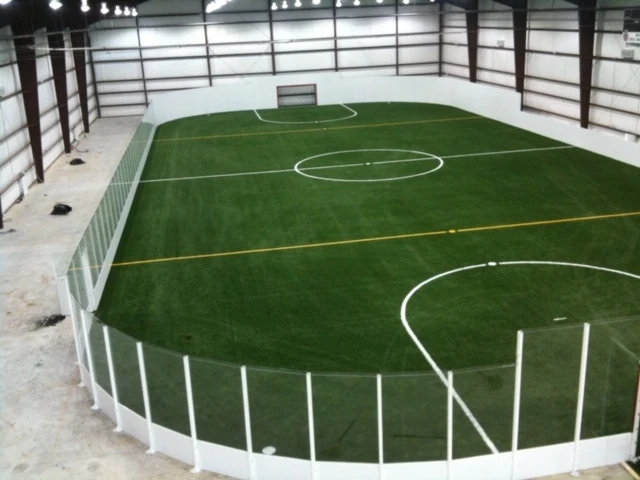
When 5-a-side soccer first became popular one of the unique aspects of the field marking was the goal (penalty) arc. From its Futsal roots many facilities have used a semicircle while others use a traditional rectangle. All facilities will have a midfield line. Some facilities will have a center circle and many will have center field kick off dot. Total Sports Surfaces are experts when it comes to inlaid turf lines. Using our experience from the vast number of 5-a-side soccer fields with have installed TSS will also explain the pro’s / con’s, of different field marking decisions
What is a 5-a-Side Soccer Field?
A 5-a-side soccer field is made up of artificial turf with some type of Dasher Board system and attached netting to keep the ball in play. 5-a-side soccer is played on artificial sports turf and facilities will decide between traditional infill turf or no-fill turf. As experts in turf installation, TSS can discuss the pro’s and con’s of each. 5-a-side soccer fields will also normally include a Dasher Boards system with attached netting to keep the ball in-play.
A 5-a-side soccer field is designed for smaller teams, shorter matches, and more dynamic playing styles. One of the unique characteristics of 5-a-side soccer fields is the penalty area, which is usually a semicircle instead of a rectangle. Regardless of the size of the field, penalty areas in 5-a-side pitches typically have a radius of 19.5 feet from the goal line’s central point. Each field should have a halfway line going across its width, and if an optional center circle is included, it should measure 9 feet across. The goals in 5-a-side soccer are also smaller compared to traditional soccer, with various sizes to choose from. Recommendations range from 12’ x 4’ to 16’ x 4’ depending on the ages of the players, or you could go with a different size that works best for your target customers. Just keep in mind that if you’re planning on catering to 5-a-side soccer leagues, they’ll want to play on fields that make for an enjoyable, competitive experience. Always comply with official recommendations.
Comparing a 5-a-Side vs a Regular Soccer Field
5-a-Side Dimensions
There’s no regulation specifying what size a 5-a-side soccer field must be, but there are recommendations that can make your facility more appealing to players. A common size for 5-a-side soccer fields is around 90’ x 60’, with recommended sizes ranging from 80’ x 50’ to 165’ x 115’. This gives you plenty of flexibility when you’re planning the layout of your 5-a-side soccer venue; if you want to install multiple pitches in the same facility, they can often be put side-by-side and separated with netting or other dividers.
Dasher Boards for a 5-a-side soccer field.
TSS uses the Flex / Strong Dasher Board/Glass system when designing their customers’ 5-a-side soccer facility. The Flex / Strong system allows facility owners to pick the height of the Dasher Board/Glass along with the type of doors and soccer goals. When it comes to 5-a-side soccer the soccer goal size should be considered. There is no standard 5-a-side soccer goal size. Some of the decisions will depend on the field size. Common goal sizes are 10’ x 6’ or 12’ x 6’ 6” or 14’ x 7’. When thinking about the soccer goal it is recommended that a header board is installed over the goal cross bar. The header board serves two important functions. #1 it keeps some of the missed shots in-play (more action) but the header also protects the netting from the wear and tear of missed shots.
TSS Pro Tip: Dasher Boards
The header board is a very important feature on indoor soccer goals. Placement of the player doors is also important. Avoid having the player doors on the end of the field. It makes it difficult to sub on the fly and will negatively affect the player experience. Doors can be 4’ High or 6’ 6” High.
Netting for a 5-a-side soccer field
In general terms perimeter and ceiling netting for a 5-a-side soccer should connect to the Flex / Strong system and go as high as possible (max height of 30’). The minimum height is up to each indoor facility. Perimeter netting from 12’ to 30’ is acceptable while 18’-20’ is the most common.
How to Install a 5-a-Side Soccer Field
The process of installing a 5-a-side soccer pitch starts with the planning stage. This is when you establish a budget, decide whether to construct a building from the ground up vs. retrofitting an existing building for an indoor sports facility. Next, you should pick the materials that will be used to build the field, ideally high-quality ones that are endorsed by experts. Working with an installation company with experience completing indoor sports projects can help you throughout the process. Then it’s time for the installation, which should be done according to your specifications. To make sure your 5-a-side field gets installed correctly, it’s recommended to find a company that uses a dedicated installation team, not one that outsources the job to sub-contractors who aren’t necessarily invested in providing good results.
Why should you consider installing a 5-a-Side soccer field
One of the big advantages of installing a 5-a-side soccer field is that it requires less sqft space and a smaller budget. Another benefit facilities owners find is that it is easier to find teams to play in a 5-a-side soccer league. A typical 5-a-side soccer team may have 7-8 players on the roster. For a larger indoor field you may need 12-14 players on your roster. At TSS, we have completed projects where a facility owner will remove two 180×80 fields and install (3) 90×60 5-a-side fields. This is not to say that every facility should only have 5 a-side fields. Many of the most successful facilities TSS works with will have 1-2 “large” fields and 1-3 5-a-side fields.
Are You Looking to Install a 5-a-Side Soccer Field?
After completing more than 1000+ projects in 40+ years of business, our team knows how to build quality, long-lasting indoor sports pitches without sacrificing the personalized attention that each of our clients deserve. Whether you’re just interested in a free quote, or you’re scheduling the install we’re about to do for you, you’ll be talking with Rob Franco, the president of TSS and the main point of contact for designing, pricing, and overall project management. If you’re ever unsure of which materials to select, which dimensions to use, or anything else that affects your project, all you need to do is ask for some input.
Our installation team members are experienced employees, not sub-contractors, which helps ensure quality control. Since 5-a-side fields are one of our specialties, we already have the materials and processes in place to build you a customized pitch. We can work with your budget requirements, optimize available space, and help you select the best materials for the project we’ve designed just for you.
FAQs: 5-a-Side Soccer Fields
What is 5-a-side soccer?
5-a-side soccer is a faster-paced version of regular soccer, and is named after the number of players on each team. With four field players and one goalie per side, each person enjoys more touches and spends more time with the ball compared to regular soccer. 5-a-side soccer is a popular option with both newbies and experts, since it’s a great way to improve your technical skills while having fun.
How is 5-a-side different from indoor soccer?
5-a-side soccer is just slightly different from indoor soccer. It is essentially a form of indoor soccer played on a smaller field, with less players and a smaller goal.
What are the benefits of 5-a-side?
There are several benefits of 5-a-side soccer, both for players and for facility owners. From a player perspective, it can be simplified to more touches with the ball increasing the players technical ability and overall enjoyment of playing. Facility owners like that it requires less sqft, a smaller financial budget and can be easier to maximize league play.
Can you build a custom 5-a-side soccer field?
Yes, since there is no standard size of a 5-a-side field, TSS considers every 5-a-side project to be “custom.” From turf style to field size, to Flex / Strong field design to netting. TSS lets the customer be in charge of all decisions.