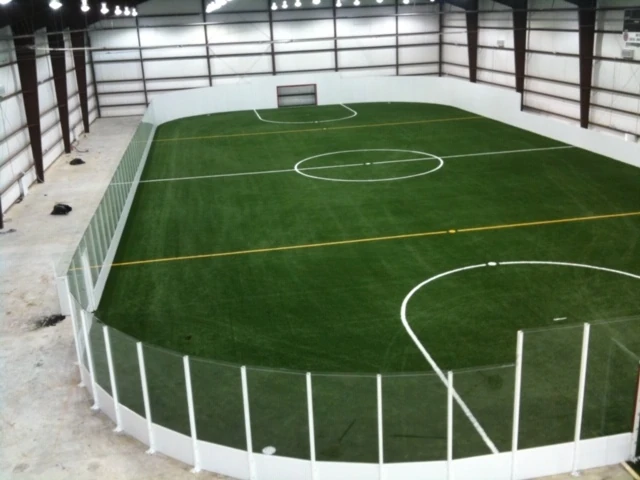
Soccer has been one of the most popular sports in the USA for years, creating plenty of demand for facilities where both casual and competitive matches can be played. If you’re thinking about building an indoor soccer facility, one of the first questions you should ask is whether you’ll be building from the ground up, or retrofitting existing infrastructure. Other important considerations include budget, business structure, target customers, etc. In order to build a top-notch indoor soccer facility, it’s important to understand the implications of each decision, and determine which is the best fit for your goals.
Overview: Building an Indoor Soccer Facility
Figuring out how to start an indoor soccer facility takes careful planning, whether you want smaller 5-a-side fields, or larger fields that can be used for professional matches. Aside from getting the dimensions right, you should also choose high-quality materials that meet or exceed industry standards. Plus, an indoor soccer field has to be inside a building by definition, so you’ll either have to figure out how to build an indoor soccer facility from the ground up, or find an existing space to retrofit. The good news? Once it’s completed, your indoor soccer field will be able to withstand years of maintenance-free use.
Key Features to Consider for Your Soccer Facility
Sports turf
This is one of the most essential parts of an indoor soccer field; not only does it need to be functional, but also durable enough to last for years. At Total Sports Surfaces, we exclusively use turf made in the USA by one of the country’s largest turf manufacturers. In addition to the most popular turf options for indoor sports facilities, we also provide customized turf if that’s what your project requires.
Field containment system
Using our 30+ years of industry experience, we’ve developed our own field containment system using steel that’s both fabricated and powder-coated in the USA. The steel is combined with either 1 1/8″ dasher boards or 1/2″ tempered glass, for an incredibly strong containment system that can be customized according to your specifications. The boards and glass come in heights of 2′, 4′, 6′, 8′, and 10′, and can be manufactured for traditional oval or rectangular shapes.
Netting and divider curtains
Netting can be used to subdivide an indoor soccer field, or installed around the perimeter to protect spectators. Divider curtains can also be used to split up a large field into smaller ones, but with the added function of acting as a visual barrier from one field to the next. TSS netting is 100% sourced from the USA, helping us ensure quality and consistency.
Rubber infill
If you decide to use infill, it’s important to know which type would work best for your indoor soccer field. The principals of TSS own one of the USA’s largest rubber manufacturing facilities, which produces a recycled EPDM rubber infill that offers superior shock absorption and durability. We also offer industry standard car tire rubber infill, to ensure that our clients have plenty of options to choose from.
What is the Process for Building an Indoor Soccer Facility?
Step 1: Determine your budget
Determining your budget is the first and most important step, since it will essentially determine the size and scope of your indoor soccer facility. Will you be spending $50,000, or $5 million? Is the budget set in stone, or is it flexible? The more planning you do in the early stages, the smaller the chances are of unwanted surprises later on.
Step 2: Evaluate the benefits of building from the ground up vs. retrofitting
Building an indoor soccer facility from scratch has the benefit of letting you customize every detail, but it can be prohibitively expensive. Retrofitting for an indoor soccer field is much less costly, but the trade-off is that finding the right building can take more time.
Step 3: Identify the best options for your business model
We consider this step to be just as important as setting your budget, since different types of indoor soccer facilities appeal to different customers. Are you aiming to attract revenue from leagues, team training, or a combination of the two? Do you want your facility to be for adult leagues, youth leagues, or both? Once you’ve formulated your ideal revenue streams, you’ll be able to identify the optimum size and number of indoor soccer fields.
Step 4: Design your indoor soccer facility
After laying the groundwork with Steps 1-3, you can get into the details of materials, dimensions, customizations, etc. Our expert team members are here to help, from providing insights on materials, to seamlessly installing your new indoor soccer facility.
FAQs: Building an Indoor Soccer Facility
What are the dimensions for an indoor soccer field?
That depends on the space you have available, as well as your business model. The most common sizes are 90 x 60 feet for 5-a-side fields, and 180 x 80 feet for larger indoor soccer fields. At TSS, we’ve built soccer fields from 45 x 30 feet to 350 x 250 feet, and everything in between.
What is the regulation for indoor soccer field size?
While there’s no “regulation size” for an indoor soccer field, we do have some recommendations to make sure your indoor soccer facility optimizes its offerings for teams and leagues. For example, a field’s length-to-width ratio can be just as important as its actual dimensions. If your maximum field width is 50 feet, then you should aim for a length of 100 to 120 feet. An overly long indoor soccer field is considered to have a “bowling alley” design, which isn’t preferred by either recreational or professional players.
How much does it cost to build an indoor soccer field?
There’s no one-size-fits-all cost to build an indoor soccer facility, but we can give you an estimate for your project if you fill us in on some key details. These include:
- Length and width of the indoor soccer field (or fields)
- Location of the facility
- Which lines you want tufted or inlaid
- Which type of turf you’d prefer, such as infill or non-infill
- Whether or not dasher boards, glass, or netting will be included
- Accessibility for forklifts and unloading materials
Once we’ve learned some of the main details, we’ll typically have your quote ready within 24 to 48 hours.
How many soccer fields should be inside the facility?
The “right” number of soccer fields for your facility is the number that works best for your business and budget. There are plenty of facilities that have two to eight 5-a-side fields, which are popular with smaller groups. Facilities with up to three fields of around 180 x 85 feet are also very common, and like 5-a-side fields, can be used for both recreation and competition. Bigger facilities may opt for a single large field that can be converted into smaller fields with divider nets — for example, a 300 x 200-foot field could be divided into three fields measuring 200 x 100 feet.
How long does it take to build an indoor soccer field?
This will depend on a large number of variables. These include the size of the field, the presence (or absence) of existing infrastructure, and even the location of the facility. If you’re including the planning stage, then that will extend the time frame even further. That being said, if you just need a quick frame of reference, our exclusive TSS install crews can build a 180 x 80-foot field within five to seven days.
